Avoid the Mistake That Cost Buffett 8 Years of Better Returns


There's one investment strategy you won't read much about on Fool.com, even though many have tried it. In fact, Warren Buffett spent eight years working with it before discarding it as worthless.

What investment strategy is that? Technical analysis.

Invest like a lemming
Technical analysis is the practice of predicting where stocks will trade based on charts of historical pricing and volume information. There's a certain logic to it. Stocks trade based on supply and demand, which is greatly influenced by investors' attitudes about the stocks. The charts should reflect those attitudes and might predict where the individual stocks will go.

It's an attractive idea. Clorox (NYSE: CLX) has bounced between $55 and $65 quite a few times in the past few years. Why not buy at the low, and sell at the high? Or look at Green Mountain Coffee Roasters' (Nasdaq: GMCR) chart. Clearly, investors love the stock. Its rise from $24 to $48 seems unstoppable. Why not jump aboard and profit?

Technical analysis is a simple yet compelling strategy. You can see why Buffett spent years early in his career trying to master it.

An expensive mistake
But Buffett discovered one small problem. Technical analysis didn't work. He explained, "I realized that technical analysis didn't work when I turned the chart upside down and didn't get a different answer."

After eight years of trying, he concluded that it was the wrong way to invest. Then he focused on the teachings of Ben Graham, which stressed business fundamentals, finding a strategy that both made sense and, more importantly, worked.

Three simple rules
The billionaire discussed that strategy at the 2008 Berkshire Hathaway (NYSE: BRK-A) general meeting. When he was asked how to avoid the crowd mind-set, he said he simply followed Graham's three most important lessons:

  1. Buy stocks with a margin of safety.
  2. A stock is part of a business.
  3. The market is there to serve you, not instruct you.

The first lesson usually makes the headlines. It means that you should buy stocks for less than they're worth. But when Buffett talks about the second and third lessons, he's basically admitting that he wasted eight years of his investing life.

Buying a business
After all, thinking about a stock as part of a business is the opposite of what technical analysis is all about. Technical analysis focuses on trading securities. It doesn't matter whether the security is a share of Suncor Energy (NYSE: SU), with its oil sands, natural gas, energy marketing, and refining segments; or whether that security is a derivative promising the delivery of three tons of Italian meatballs. It's all the same because technical analysis doesn't care about the business -- or the fundamentals.

In Graham's second lesson, stocks are far more than just pieces of paper or lines on graphs, and to understand them, you need to understand the business. If you're looking at Under Armour (NYSE: UA), ignore whether the stock has been up three days in a row, and focus instead on how the company plans to address its inventory management issues.

Ways to serve man and woman
Similarly, when Buffett says the market isn't there to instruct, he's saying the movements in the market aren't telling you how to invest.

When Wells Fargo (NYSE: WFC) fell under $2 per share in 1990 (adjusted for splits and dividends), the market was saying that poor-performing California residential loans would sink the company.

When McDonald's hit $13 in 2003, the market was announcing that the Big Mac would end up in the Museum of Neat Ideas Gone Wrong, alongside the tapeworm diet, land wars in Asia, and Paris Hilton's home videos.

But in both cases, the market was wrong.

So, instead of listening to the market, Buffett seeks to take advantage of it. Sometimes, the market will offer to buy a stock for far more than it's actually worth. Other times, it'll offer you the chance to buy shares of a great company for far less than its fair value. An investor who understands the true value of a business will be able to profit when the market offers great companies on sale.

The Foolish bottom line
You can learn from Buffett's error -- don't focus on charts. Instead, understand businesses and seek excellent stocks that the market offers at low prices. These days, the market is particularly treacherous. Some stocks that seem cheap will turn out to be very expensive. Others that are simply beaten down by negativity will post amazing returns.

Link: http://www.fool.com/investing/value/2009/03/28/avoid-the-mistake-that-cost-buffett-8-years-of-bet.aspx

Don't Fall for Citigroup's Fantasy

Overdue, but never late than never. Interesting news on Citi, when I was doing my reservist.

---------------------------

Markets exploded today because of a memo from Citigroup (NYSE: C) CEO Vikram Pandit, telling employees that -- surprise! -- the bank was actually on track to post its best quarter in over a year ... and a profit! Maybe things aren't as bad as we thought! We're saved! We're saved! Whoo-hoo!

Not so fast
You can't blame the market's reaction. Since Feb. 6, the Dow Jones has risen all of five times. Even relatively healthy banks like JPMorgan Chase (NYSE: JPM) and Wells Fargo (NYSE: WFC) are being treated like basket cases. Anything that can be slightly spun as good news is bound to be clinged to. Just give us any good news -- even if it's not, you know, true -- and the market will run with it.

This is no exception. Citigroup's announcement that "Hey, hey, we're actually profitable!" is twisted, tortured, and largely irrelevant to its ultimate fate.

The gist of Pandit's memo was that operating profit was going gangbusters -- as if operating profit has been the problem all along. The problem is not a bank's ability to generate current income, but its ability to absorb losses on legacy assets that are worth a fraction of their purchase price -- using absurd amounts of leverage to boot.

The memo disclosed numbers that point to an operating profit of about $8.3 billion this quarter, but Pandit didn't give any mention of what asset writedowns would be. "In January and February alone, our revenues excluding externally disclosed marks were $19 billion," he said. Great! Now... uh... about those "externally disclosed marks?" How are those workin' out for you?

I'm not worried that Citigroup can't generate operating profit: I'm worried it's not solvent. There's a big difference. Imagine a person drowning in debt but insisting they're wealthy because their paycheck exceeded their grocery bills. You get the idea.

Same game, different day
You can't blame bank CEOs for trying to instill confidence these days. Bank of America (NYSE: BAC) tried a similar approach a few weeks ago, telling investors that Countrywide and Merrill Lynch were the "stars" of 2009, and that Merrill Lynch will be "a thing of beauty," pointing to, you guessed it, operating profits.

It doesn't take a tremendous amount of thought to see that if a company has an operating profit of X and losses on existing assets of X times 100, things might not turn out so hot. Such is the case with Merrill Lynch, whose losses in 2007 and 2008 wiped out all profits earned over the preceding eleven years, and ultimately caused B of A to become the recipient of one of the largest federal bailouts ever. "A thing of beauty" indeed.

Posting the occasional operating profit will indeed provide a cushion for banks to absorb impending writedowns, but it's a clown show to think it'll be enough to plug the black hole of losses, especially in Citigroup's case.

Link: http://www.fool.com/investing/dividends-income/2009/03/10/dont-fall-for-citigroups-fantasy.aspx

ANALYSIS-Wagoner's exit puts B of A CEO Lewis in hotseat

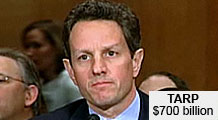
Geithner: $135B left for bank bailouts

March 29, 2009: 9:56 AM ET

WASHINGTON (Reuters) -- U.S. Treasury Secretary Geithner said Sunday the government has about $135 billion left for bank bailouts and refused to say whether it will ask Congress for more this year.

"We have roughly $135 billion left of uncommitted resources. The rest is out the door," he said on ABC Television's "This Week with George Stephanopoulos."

Geithner said that figure included "a very conservative judgment about how much money is likely to come back from banks that are strong enough not to need this capital now to get through a recession."

Congress approved $700 billion last fall for rescuing banks that had gotten into trouble when the U.S. housing boom crashed, but lawmakers and ordinary Americans show signs of becoming increasingly unhappy over the program.

Geithner wouldn't specify whether he expects to ask Congress for more money this year, though he didn't rule it out. "The important thing is we are going to work with the Congress to make sure we have the resources needed to do this right," he said.

"We have substantial resources, we're going to use them quickly, as carefully as we can...to get credit flowing again and we'll cross that bridge when we come to it in terms of whether we'll need additional resources," Geithner added.

He conceded that banks likely will need "large amounts of assistance" before the credit crisis is resolved and said it would be "a mistake" to think that they can earn their way out of the current downturn.

"To get through this, governments need to act. There's a great obligation and responsibility for government to act to solve these things," Geithner said. "The market will not solve this and the great risk for us is that we do too little, not that we do too much."

Link: http://money.cnn.com/2009/03/29/news/economy/bailout_funds.reut/index.htm?postversion=2009032909

-----

The portion in bold is critical, esp when banks are all reporting out that they are making profits. When the 1st quarter results are out, we will probably determine whether the markets will be moving north or south again.

Bankers: Take your TARP money back

Some banks say the government's stabilization plan is actually weighing them down.

By Allan Chernoff, CNN senior correspondent

Obama aides flunk GM and Chrysler

Latest news from US, which caused a massive plunge in most of the markets.

------

By Peter Valdes-Dapena, CNNMoney.com senior writer

NEW YORK (CNNMoney.com) -- The Obama administration gave General Motors and Chrysler LLC failing grades Monday for their turnaround efforts and promised a sweeping overhaul of the troubled companies. The government plans to give the automakers more money, but it is also holding out the threat of a "structured bankruptcy."

The federal government will provide operating funds for both automakers for several weeks, during which time the companies will have to undergo significant restructuring, administration officials said late Sunday night.

At GM, part of that restructuring began early Monday when CEO Rick Wagoner announced his resignation, which he said came at the request of the Obama administration.

President Obama is expected to make a formal announcement later in the day about his plans for the companies, which have already been given $17.4 billion.

GM (GM, Fortune 500) will get 60 days and Chrysler 30 days in which to make a final push toward proving they can run viable businesses. If Chrysler succeeds, it will receive a $6 billion loan. In GM's case, the officials would not specify how much money the carmaker might receive.

In the case of both companies, the officials said, stakeholders - and particularly debt holders in both companies - had not done enough to relieve the automakers of ongoing financial burdens.

"We have made very clear that we expect a very, very substantial reduction in liability for both companies," one official said.

The administration also said a structured bankruptcy is possible.

"While Chrysler and GM are different companies with different paths forward, both have unsustainable liabilities and both need a fresh start," according to an administration document. "Their best chance at success may well require utilizing the bankruptcy code in a quick and surgical way."

In order to help assuage consumer fears about buying cars from these companies as they restructure, the government is also setting aside funds to back up warranties on vehicles GM and Chrysler sell.

GM: Changes at the top

The administration officials were far more positive in their tone regarding the prospects for GM than for its smaller rival.

"We are very confident GM can survive and thrive as a company," one official said, noting the company's global reach, the strength of its research and development and the power of its various brands.

Nevertheless, significant changes are on the table.

One was the resignation of chief executive Wagoner, a 32-year veteran of the company who has served in the top post since 2000.

"On Friday I was in Washington for a meeting with administration officials. In the course of that meeting, they requested that I 'step aside' as CEO of GM, and so I have," Wagoner said in a statement posted to the GM Web site.

Wagoner will be replaced by GM's chief operating officer, Fritz Henderson. Kent Kresa will serve as interim chairman.

"Having worked closely with Fritz for many years, I know that he is the ideal person to lead the company through the completion of our restructuring efforts. His knowledge of the global industry and the company are exceptional, and he has the intellect, energy, and support among GM'ers worldwide to succeed," Wagoner said.

"We view our approach to GM as starting with a clean sheet of paper," the Treasury official said.

The officials said they had committed to working with GM to create a leaner, more competitive company. Administration officials will be in Detroit working very closely with the GM executives on a plan to restructure the company and its debt obligations, the officials said.

The administration officials would not say how much more money they might ultimately lend to GM or how much working capital the automaker would need to make it through the next 60 days.

Chrysler: Fiat or bust

For its part, Chrysler was too reliant on the domestic auto market, according to the officials. In addition, a significant "hollowing out" of the company by its past owners had left it unable to compete effectively as a stand-alone company, the officials said.

Any restructuring for Chrysler would have to involve a partnership, most likely a deal with Fiat which has had an "agreement in principal" with Chrysler since January.

Chrysler is getting 30 days to work out a deal with Fiat, which is the only way the officials believe the carmaker will survive. If that can happen, the administration is prepared to lend Chrysler $6 billion dollars more.

While government officials said it was their "goal, hope and ambition" for a Chrysler-Fiat deal to work, the agreement terms would need to be modified from what the companies had previously announced.

Fiat had originally planned to take a 35% stake in Chrysler, but that stake would have to be lower. Fiat would also not be allowed to own a majority stake in Chrysler until after all government loans have been repaid.

There is sufficient money in existing funds to finance these plans, the officials said, who added that there would be no immediate need to ask Congress to appropriate more.

CNNMoney.com senior writer Jennifer Liberto contributed to this report.

Link: http://money.cnn.com/2009/03/29/news/companies/gm_bailout/index.htm?postversion=2009033010

Three examples of good debt

Do take note that this is taken as an example of being in USA.

------------

Home, school and your chariot qualify


Debt is not always a bad thing. In fact, there are instances where the leveraging power of a loan actually helps put you in a better overall financial position.

Buying a home

The chance that you can pay for a new home in cash is slim. Carefully consider how much you can afford to put down and how much loan you can carry. The more you put down, the less you'll owe and the less you'll pay in interest over time.

Although it may seem logical to plunk down every available dime to cut your interest payments, it's not always the best move. You need to consider other issues, such as your need for cash reserves and what your investments are earning.

Also, don't pour all your cash into a home if you have other debt. Mortgages tend to have lower interest rates than other debt, and you may deduct the interest you pay on the first $1 million of a mortgage loan. (If your mortgage has a high rate, you can always refinance later if rates fall. Use our calculator to determine how much you might save.)

A 20 percent down payment is traditional and may help buyers get the best mortgage deals. Many homebuyers do put down less - as little as 3 percent in some cases. But if you do, you'll end up paying higher monthly mortgage bills because you're borrowing more money, and you will have to pay for primary mortgage insurance (PMI), which protects the lender in the event you default.

For more on financing a home, read Money 101: Buying a home.

Paying for college

When it comes to paying for your children's education, allowing your kids to take loans makes far more sense than liquidating or borrowing against your retirement fund. That's because your kids have plenty of financial sources to draw on for college, but no one is going to give you a scholarship for your retirement. What's more, a big 401(k) balance won't count against you if you apply for financial aid since retirement savings are not counted as available assets.

It's also unwise to borrow against your home to cover tuition. If you run into financial difficulties down the road, you risk losing the house.

Your best bet is to save what you can for your kids' educations without compromising your own financial health. Then let your kids borrow what you can't provide, especially if they are eligible for a government-backed Perkins or Stafford loans, which are based on need. Such loans have guaranteed low rates; no interest payments are due until after graduation; and interest paid is tax-deductible under certain circumstances.

For more on educational financing, read Money 101: Saving for College and "Beating the Financial Aid Trap."

Financing a car

Figuring out the best way to finance a car depends on how long you plan to keep it, since a car's value plummets as soon as you drive it off the lot. It also depends on how much cash you have on hand.

If you can pay for the car outright, it makes sense to do so if you plan to keep the car until it dies or for longer than the term of a high-interest car loan or pricey lease. It's also smart to use cash if that money is unlikely to earn more invested than what you would pay in loan interest.

Most people, however, can't afford to put down 100 percent. So the goal is to put down as much as possible without jeopardizing your other financial goals and emergency fund. Typically, you won't be able to get a car loan without putting down at least 10 percent. A loan makes most sense if you want to buy a new car and plan to keep driving it long after your loan payments have stopped.

You may be tempted to use a home equity loan when buying a car because you're likely to get a lower interest rate than you would on an auto loan, and the interest is tax-deductible. But before going this route make sure you can afford the payments. If you default, you could lose your home. And be sure you can pay it off while you still have the car since it's painful to pay for something that has been consigned to the junkyard.

Leasing a car might be your best bet if the following applies: you want a new car every three or four years; you want to avoid a down payment of 10 percent to 20 percent; you don't drive more than the 15,000 miles a year allowed in most leases; and you keep your vehicle in good condition so that you avoid end-of-lease penalties.

Whatever route you choose, shop for the best deals. Remember, it's in the car dealer's best interest to finance at the highest rate possible, so look at what you'll pay overall, not just the monthly amount. If you tell your car dealer you can spend $400 a month, you could end up with a new car for $400 a month based on an uncompetitive interest rate.

Link: http://money.cnn.com/magazines/moneymag/money101/lesson9/index3.htm

-----

Strangely, buying a car is a good debt. However, in Singapore context, it seemed warped as our cars can only last us for 10 years before our COE expires. Furthermore, I guess our parking fees in the long run may even be more expensive than the car itself! Imagine the season parking fees in Capital Towers is $350 per month!

Good debt vs. bad debt

Some useful article for money management.

Sometimes it makes sense to borrow - a lot of times it doesn't.

It's almost impossible to live debt-free; most of us can't pay cash for our homes or our children's college educations. But too many of us let debt get out of hand.

Ideally, experts say, your total monthly long-term debt payments, including your mortgage and credit cards, should not exceed 36 percent of your gross monthly income. That's one metric mortgage bankers consider when assessing the creditworthiness of a potential borrower.

It's far too easy to spend more than you can afford, especially when you pay by credit card. The average U.S. household with at least one credit card carries nearly a $10,700 balance, according to CardWeb.com, and personal bankruptcies have hit record highs in recent years.

Of course, avoiding debt at any cost is not smart either if it means depleting your cash reserves for emergencies. The challenge is learning how to judge which debt makes sense and which does not and then wisely managing the money you do borrow.

Good debt includes anything you need but can't afford to pay for up front without wiping out cash reserves or liquidating all your investments. In cases where debt makes sense, only take loans for which you can afford the monthly payments.

Bad debt includes debt you've taken on for things you don't need and can't afford (that trip to Bora Bora, for instance). The worst form of debt is credit-card debt, since it usually carries the highest interest rates.

Sometimes the decision to borrow doesn't hinge on how much cash you have but on whether there are ways to make your money work harder for you. If interest rates are low, compare what you'll spend in interest on a loan versus what your money could earn if it were invested. If you think you can get a higher return from investing your cash than what you'll pay in interest on a loan, borrowing a small amount at a low rate may make sense.

Link: http://money.cnn.com/magazines/moneymag/money101/lesson9/index2.htm

----------

I will put what they claim as a good debt in a short while.

Does Wall Street need bonuses now?

An interesting article to ponder on. Especially when we, the workers are involved.
------------

People are angry about the AIG bonuses, but do executives really need incentives to stay on the job in this environment? Here's where the financial sector jobs and paychecks are -- and where they aren't.


By Jennifer Reingold, senior writer

Oil speculation: It's back

With the recovery everyone is anticipating, this is something that I worry again. US$200 per barrel for oil once more? Even though this article is quite some time back, but it brings good reflection on where our economy is going, especially the rising prices of commodities.

------

There's more of it today than there ever was this summer. And this time around, it really is making oil more expensive.

By Jon Birger, senior writer
Last Updated: December 5, 2008: 1:55 PM ET

NEW YORK (Fortune) -- With oil now at $50 a barrel, you no longer hear Congress complaining about oil speculators. The irony is there's probably more real speculation going on today than there ever was back in June and July.

I'm talking about the type of speculation that involves hoarding oil today so it can be sold for more down the road. Today's speculators are actually buying oil. They're not merely flipping futures contracts without taking delivery - which is what hedge funds and commodities index funds were doing when they were in the crosshairs of Congress this summer. As I've argued before, investors who trade futures but never take delivery of actual oil can't have a material impact on oil prices because their trading affects neither supply nor demand.

What's different now is the structure of the futures market, which is giving big investors an incentive to buy and hold huge sums of crude. Specifically, the November 2009 price of oil is considerably higher ($12 a barrel higher, to be precise) than the spot price - a scenario futures traders call a "contango" market. (The opposite scenario - spot prices higher than futures prices - is known as "backwardation.")

"The steepening of the contango has opened up carry-trade arbitrage opportunities that are slow to be closed due to constrained credit conditions," Goldman Sachs wrote in a recent research report. Translation: this is a great time for investors to be hoarding oil.

Today's market is giving Goldman clients and other well-heeled investors an opportunity to buy oil in the spot market for $50 a barrel, sell it forward in the futures market for $62, and then pocket the $12-a-barrel difference, less storage costs.

This type of oil investing was quite popular in 2005 and 2006 when, like today, the price of oil one year out was much higher than the spot price. Back then, contango trades were so popular that one of Morgan Stanley's top energy traders, Olav Refvik, leased so much oil storage that he earned the nickname "the King of New York Harbor."

There's no question the investing strategies pursued by Refvik and others were pushing up oil prices. By putting large sums of oil into storage, they reduced the supply available to consumers. By 2007, however, the gap between spot prices and futures vanished, and so did the opportunity to profit from that difference. And the amount of oil held in inventory began to fall.

Nevertheless, Congress needed a scapegoat for rising oil prices and an easy target proved to be hedge funds and other investors dabbling in oil futures. But these pseudo-speculators were simply making a bet on the direction of prices; they weren't driving them. Their gains (or losses) came out of the hides of the investors or airlines or oil companies on the other sides of their trades, not the oil-consuming public. Moreover, a lot of commodities hedge funds were actually making the wrong bets: According to Merrill Lynch, the average commodities hedge fund had a negative trailing 12-month return through June.

Unlike futures flippers, contango traders really do impact oil prices, yet they're getting a free pass. According to the U.S. Energy Information Agency, domestic oil inventories have risen 9% since oil prices peaked in early July. While some of that is attributable to the weak economy and slack energy demand, gasoline consumption declined only 5% over the same period and gasoline inventories have risen only 4%. (If you're wondering why contango traders would target crude oil but not gasoline, vaporization issues make gasoline harder to store.)

Demand for oil storage is so keen today that some big investors who can't secure storage on land have resorted to leasing supertankers and using them as floating oil tanks. For example, the U.S. oil trading firm Koch Supply & Trading recently leased the 2-million-barrel-capacity Dubai Titan, a Koch spokesperson confirms, the third supertanker Koch has leased this year.

It's hard to quantify exactly much lower gas prices might be were it not for the current speculation. In the United States alone, crude oil inventories have increased by 27 million barrels since early July, the equivalent of about 200,000 barrels a day being pulled off the market. Based on the estimates I've seen, a 200,000 barrel-a-day decrease in supply could raise gasoline prices by anywhere from 20 to 40 cents a gallon.

For the average consumer, that's real money. But I bet you a barrel or two that actual oil investors like Koch never get targeted by Congress the same way the hedge funds and index funds did this past summer.

After all, who needs a scapegoat when gas is $1.90 a gallon?

Link: http://money.cnn.com/2008/11/26/news/economy/oil_speculation.fortune/index.htm?postversion=2008120109