10 countries, 10 solutions

United Kingdom

GDP -1.2%
Inflation 0.1%
Unemployment 6.3%
Markets -11.2%
Gallon of gas $4.85
Interest Rates 0.5%

Challenges The pound fell to a 23-year low against the dollar in January 2009 as the banking sector continued to post historic losses. The country's productivity and home values have plummeted, leading the nation's economy into a recession.

Solutions Prime Minister Gordon Brown unveiled a $63 billion bailout for the banking sector in October. In January, the Bank of England set up a special fund to buy up to $74 billion of high-quality private sector assets. The new plan also created a wide scale insurance program aimed at protecting banks against further losses and guarantee bank assets backed by mortgages and other loans.

Link: http://money.cnn.com/galleries/2009/news/0903/gallery.g20_economies/2.html

10 countries, 10 solutions

A financial crisis has engulfed countries from the best-off to the worst-off around the world. The solutions to the problem are varied.

United States

GDP -1.6%
Inflation 0.2%
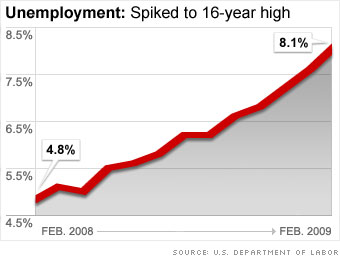
Unemployment 8.1%
Markets -10.7%
Gallon of gas $1.99
Interest Rates 0% to 0.25%

Challenges Home prices have plummeted since the summer of 2007, devaluing many of banks' holdings that were backed by mortgages. To prevent further losses, banks largely stopped lending. The economic downturn that ensued led the economy to shed 4.4 million jobs in the past 14 months.

Solutions The government flooded the frozen financial system with trillions of dollars of unprecedented liquidity programs, including a $700 billion bank bailout. After a $168 billion stimulus package unveiled in February 2008, the Obama administration produced another $787 billion stimulus plan in February 2009.

Link: http://money.cnn.com/galleries/2009/news/0903/gallery.g20_economies/index.html

Warning: Bear isn't hibernating yet

Some fear the bear will return in April. Even if the economy has hit bottom, the news may just be 'less bad'; GM, bank stress tests and earnings are concerns.

By Paul R. La Monica, CNNMoney.com editor at large

DBS Vickers (Spore):Market Focus: Equity Strategy : Trading opportunity

By Janice Chua (65) 6398 7954

The current bear market rally is being driven by a normalization of the equity risk premium as global risk aversion subsides. This presents investors with a near term trading opportunity. However, until there is a convincing turn in the fundamentals, the risks remain that the re-emergence of systemic risk factors could curtail the nascent rebound.

Equity risk premium in normalization mode as sentiment improves and economy show signs of bottoming. Sentiment seems to be improving with bad news well absorbed by the market as the market searches for signs of stability in the financial market. Initial signs of the economy bottoming out in US and Singapore will raise investors’ risk appetite. Equity risk premium for the Singapore market was close to its peak last quarter at 5.5%. A normalizing of ERP closer to 3% could trigger the bear market rally, even as we wait for confirmation of an eventual recovery in the economy.

Market bottoms when GDP bottoms – 2Q09 the inflexion point?
Based on DBS Economist forecasts, Singapore’s GDP will hit two more extreme negative quarters – the weakest quarter is in 1Q09 -7.8%, –6.9% (2Q09) and –5.2% in 3Q09. We think 2Q09 holds a key inflexion point for a market bottom, and volatility will persist – we expect a trading range of 1200 to 2000, providing investors opportunity to accumulate as the market weakens.

Narrowing the valuation gap to 2100 assuming PE normalizes. At 1585, the STI’s PE rises to 10.2x (09F) on earnings decline of 19%. Assuming PE rating normalizes back to 1 standard deviation of 13.5x, the target STI will be 2100. Our stock picks this quarter are early cyclicals trading on low cycle PE : SembCorp Marine, City Developments, Venture Manufacturing,
OCBC or stocks trading on bombed out valuation SPH and A REIT.

(Document link: Singapore Research)

China stocks vs US stocks

I have been reading quite a number of posts in forums lately lambasting how untrustworthy S shares are, how it is a con job etc etc.

Lets compare apple to apple, China vs USA.

While Lehman Brothers loss and collapse caused a massive tsunami into the financial system, which S shares or china stock could have done an impact as such? Take note that Lehman Brothers at the brink of destruction were still telling the public they are solvent and sound!

Next, Madoff's ponzi scheme. How long did it last? Well, really noone knows.

Last but not least, the massive collapse of the big US banks, which is causing banks, economic systems, sovereign wealth funds around the world falling with them.

But nevertheless, psychologically, people still have faith in USA rather than China. While everyone is shooting china stocks as cheats, swindlers, what happen to US stocks?

How Banks Can Exploit Geithner's Plan

But I'm also a realist. There are several reasons to think that Geithner's plan to form a public-private investment partnership will not only fail, but will become a massive wealth transfer from taxpayers to banks. When the plan first came out last week, I didn't think such a transfer was likely. With a simple example, I now realize otherwise.

No buyers, no sellers
The gap between what banks like Wells Fargo (NYSE: WFC) or Bank of America (NYSE: BAC) are willing to sell for and what investors are willing to pay is gigantic. If AIG (NYSE: AIG) wants to sell an asset for $0.80 on the dollar, yet private investors are only willing to pay $0.40 on the dollar, we get nowhere.

To solve this dilemma, Geithner's plan provides 85% nonrecourse financing to private investors. The Treasury then splits the equity 50/50. So, to buy an asset for $100, private investors only have to risk about $8. While that seems like an unfair risk for taxpayers, private investors theoretically won't overpay, because they can lose every dime they put in. In all likelihood, that'll prove to be the case most of the time.

Unless …
Yet with a little creativity, it's easy to see how banks could sell assets at extravagant prices -- perhaps 100 cents on the dollar -- while dumping most of the risk on taxpayers. Private investors who participate in this plan, you see, have sole authority to set the bid price on assets. As the Treasury's recent press release states:

The highest bid from the private sector … [will] define the total price paid by the private investors and the Treasury.

Hence, banks have a huge incentive to get someone to bid exorbitant prices. Who is that "someone"? Well, that's where things could get shady.

According to the Treasury, investors who meet a few simple criteria pre-qualify to participate in the plan. For example, pre-qualified investors must have:

  • Capacity to raise at least $500 million of private capital.
  • Experience investing in eligible assets, including through performance track records.
  • A minimum of $10 billion of assets under management.
  • Headquarters in the United States.

All pretty simple. Oodles and oodles of hedge funds and private equity funds fit those requirements.

Trouble is, you can draw a straight line from banks to some of those seemingly "independent" private investors. Hedge funds in particular have extraordinarily tight relationships with investment banks like JPMorgan Chase (NYSE: JPM), Goldman Sachs (NYSE: GS), or Morgan Stanley (NYSE: MS) that often play ball on the same court.

In fact, private investment partnerships can actually be owned by banks themselves. For example, Lehman Brothers invested in, provided management for, and supplied office space to a hedge fund called R3 Capital Partners last year. It then sold $4.5 billion worth of assets to R3 at undisclosed prices. For whatever reason, Lehman essentially sold assets to itself through an "independent" entity.

Welcome to the ingenuity of Wall Street -- throw in a little creativity and fancy structuring, and suddenly the distinction between banks selling assets and private investors buying assets is blurred.

Here's a simple example of how this could derail the success of Geithner's plan:

  • Bank A has a toxic asset no sane investor would pay more than $30 for.
  • Bank A gets Private Investor B -- an entity with ties to Bank A itself -- to participate in Geithner's plan and pay full price for the asset -- $100, in this case.
  • Bank A receives $100. Expect something similar to Citigroup's (NYSE: C) famous "We're saved! Everything is fine!" memo to follow.

In due time, the asset's true value -- $30 -- is realized. Since Private Investor B only put up a sliver of equity, it loses its $7 and walks away. No biggie.

Now connect the dots:

  • Bank A sold an asset worth $30 for $100 -- it made a $70 windfall.
  • Private Investor B -- with ties to Bank A -- loses only $7 when those assets go bad. Bank A happily repays $7 to Private Investor B for the trouble. Everybody wins, except for …

… the taxpayer
Since government-issued nonrecourse leverage is involved, banks can simply overbid for assets via "independent" investors and funnel most of the risk onto taxpayers. Heads they win, tails you lose.

Like I've said before, 2+2 is never going to equal 100, no matter how many bells and whistles you slap on these bailouts. If the goal is to recapitalize banks in an efficient manner, there are other sensible ways to do it. Giving banks the ability to write their own ticket isn't one of them.

G20: Confronting the crisis

World leaders will convene in London on April 2 to discuss how to prevent another global economic crisis from happening again. Here is a snapshot of 10 key economies and the challenges they face.

Link: http://money.cnn.com/news/specials/storysupplement/global_crisis/index.html

By David Goldman

Gallery: 10 economies in decline


Country

GDP growth*

Inflation

Unemployment

Stock market decline

Gallon of gas
Interest Rates
Brazil 1.80% 5.90% 8.20% 6.90% $4.17 11.25%
China 6.70% -1.60% 9%** 22.10% $3.01 5.31%
Germany -2.50% 1.00% 7.90% -11.90% $5.97 1.50%
Iceland -10.00% 17.60% 6.60% -9.00% $8.20 18.00%
India 5.10% 10.40% 6.80% -7.00% $4.06 5.50%
Japan -2.60% 0.00% 4.10% -4.20% $4.09 0.10%
Mexico 0.30% 6.20% 5.00% 9.30% $2.19 6.75%
Russia -0.70% 12.00% 8.10% 16.20% $2.81 13.00%
United Kingdom -1.20% 0.10% 6.30% -11.20% $4.85 0.50%
United States -1.60% 0.20% 8.10% -10.70% $1.99 0% to 0.25%

Avoid the Mistake That Cost Buffett 8 Years of Better Returns


There's one investment strategy you won't read much about on Fool.com, even though many have tried it. In fact, Warren Buffett spent eight years working with it before discarding it as worthless.

What investment strategy is that? Technical analysis.

Invest like a lemming
Technical analysis is the practice of predicting where stocks will trade based on charts of historical pricing and volume information. There's a certain logic to it. Stocks trade based on supply and demand, which is greatly influenced by investors' attitudes about the stocks. The charts should reflect those attitudes and might predict where the individual stocks will go.

It's an attractive idea. Clorox (NYSE: CLX) has bounced between $55 and $65 quite a few times in the past few years. Why not buy at the low, and sell at the high? Or look at Green Mountain Coffee Roasters' (Nasdaq: GMCR) chart. Clearly, investors love the stock. Its rise from $24 to $48 seems unstoppable. Why not jump aboard and profit?

Technical analysis is a simple yet compelling strategy. You can see why Buffett spent years early in his career trying to master it.

An expensive mistake
But Buffett discovered one small problem. Technical analysis didn't work. He explained, "I realized that technical analysis didn't work when I turned the chart upside down and didn't get a different answer."

After eight years of trying, he concluded that it was the wrong way to invest. Then he focused on the teachings of Ben Graham, which stressed business fundamentals, finding a strategy that both made sense and, more importantly, worked.

Three simple rules
The billionaire discussed that strategy at the 2008 Berkshire Hathaway (NYSE: BRK-A) general meeting. When he was asked how to avoid the crowd mind-set, he said he simply followed Graham's three most important lessons:

  1. Buy stocks with a margin of safety.
  2. A stock is part of a business.
  3. The market is there to serve you, not instruct you.

The first lesson usually makes the headlines. It means that you should buy stocks for less than they're worth. But when Buffett talks about the second and third lessons, he's basically admitting that he wasted eight years of his investing life.

Buying a business
After all, thinking about a stock as part of a business is the opposite of what technical analysis is all about. Technical analysis focuses on trading securities. It doesn't matter whether the security is a share of Suncor Energy (NYSE: SU), with its oil sands, natural gas, energy marketing, and refining segments; or whether that security is a derivative promising the delivery of three tons of Italian meatballs. It's all the same because technical analysis doesn't care about the business -- or the fundamentals.

In Graham's second lesson, stocks are far more than just pieces of paper or lines on graphs, and to understand them, you need to understand the business. If you're looking at Under Armour (NYSE: UA), ignore whether the stock has been up three days in a row, and focus instead on how the company plans to address its inventory management issues.

Ways to serve man and woman
Similarly, when Buffett says the market isn't there to instruct, he's saying the movements in the market aren't telling you how to invest.

When Wells Fargo (NYSE: WFC) fell under $2 per share in 1990 (adjusted for splits and dividends), the market was saying that poor-performing California residential loans would sink the company.

When McDonald's hit $13 in 2003, the market was announcing that the Big Mac would end up in the Museum of Neat Ideas Gone Wrong, alongside the tapeworm diet, land wars in Asia, and Paris Hilton's home videos.

But in both cases, the market was wrong.

So, instead of listening to the market, Buffett seeks to take advantage of it. Sometimes, the market will offer to buy a stock for far more than it's actually worth. Other times, it'll offer you the chance to buy shares of a great company for far less than its fair value. An investor who understands the true value of a business will be able to profit when the market offers great companies on sale.

The Foolish bottom line
You can learn from Buffett's error -- don't focus on charts. Instead, understand businesses and seek excellent stocks that the market offers at low prices. These days, the market is particularly treacherous. Some stocks that seem cheap will turn out to be very expensive. Others that are simply beaten down by negativity will post amazing returns.

Link: http://www.fool.com/investing/value/2009/03/28/avoid-the-mistake-that-cost-buffett-8-years-of-bet.aspx

Don't Fall for Citigroup's Fantasy

Overdue, but never late than never. Interesting news on Citi, when I was doing my reservist.

---------------------------

Markets exploded today because of a memo from Citigroup (NYSE: C) CEO Vikram Pandit, telling employees that -- surprise! -- the bank was actually on track to post its best quarter in over a year ... and a profit! Maybe things aren't as bad as we thought! We're saved! We're saved! Whoo-hoo!

Not so fast
You can't blame the market's reaction. Since Feb. 6, the Dow Jones has risen all of five times. Even relatively healthy banks like JPMorgan Chase (NYSE: JPM) and Wells Fargo (NYSE: WFC) are being treated like basket cases. Anything that can be slightly spun as good news is bound to be clinged to. Just give us any good news -- even if it's not, you know, true -- and the market will run with it.

This is no exception. Citigroup's announcement that "Hey, hey, we're actually profitable!" is twisted, tortured, and largely irrelevant to its ultimate fate.

The gist of Pandit's memo was that operating profit was going gangbusters -- as if operating profit has been the problem all along. The problem is not a bank's ability to generate current income, but its ability to absorb losses on legacy assets that are worth a fraction of their purchase price -- using absurd amounts of leverage to boot.

The memo disclosed numbers that point to an operating profit of about $8.3 billion this quarter, but Pandit didn't give any mention of what asset writedowns would be. "In January and February alone, our revenues excluding externally disclosed marks were $19 billion," he said. Great! Now... uh... about those "externally disclosed marks?" How are those workin' out for you?

I'm not worried that Citigroup can't generate operating profit: I'm worried it's not solvent. There's a big difference. Imagine a person drowning in debt but insisting they're wealthy because their paycheck exceeded their grocery bills. You get the idea.

Same game, different day
You can't blame bank CEOs for trying to instill confidence these days. Bank of America (NYSE: BAC) tried a similar approach a few weeks ago, telling investors that Countrywide and Merrill Lynch were the "stars" of 2009, and that Merrill Lynch will be "a thing of beauty," pointing to, you guessed it, operating profits.

It doesn't take a tremendous amount of thought to see that if a company has an operating profit of X and losses on existing assets of X times 100, things might not turn out so hot. Such is the case with Merrill Lynch, whose losses in 2007 and 2008 wiped out all profits earned over the preceding eleven years, and ultimately caused B of A to become the recipient of one of the largest federal bailouts ever. "A thing of beauty" indeed.

Posting the occasional operating profit will indeed provide a cushion for banks to absorb impending writedowns, but it's a clown show to think it'll be enough to plug the black hole of losses, especially in Citigroup's case.

Link: http://www.fool.com/investing/dividends-income/2009/03/10/dont-fall-for-citigroups-fantasy.aspx

ANALYSIS-Wagoner's exit puts B of A CEO Lewis in hotseat